We Asked for Clarity, We Got Chaos: The Complicated Love Affair American Soccer Fans Have With VAR
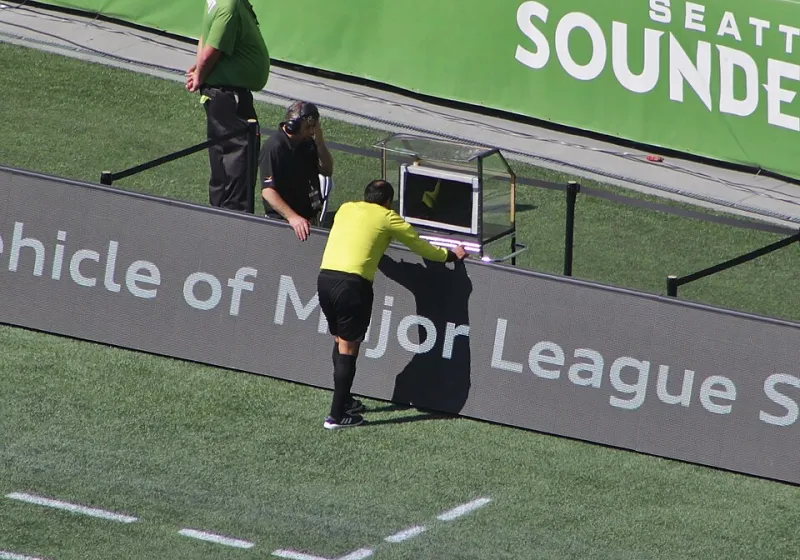
Photo: SounderBruce, CC BY-SA 4.0, via Wikimedia Commons
Picture this: It's the 88th minute. Your team just scored. The stadium erupts. Strangers are hugging. Someone spills a beer and nobody cares. Then comes the pause — that awful, loaded silence — while a guy in a booth somewhere squints at a frozen frame and decides whether your joy was real or not.
Welcome to modern soccer. Welcome to VAR.
Video Assistant Referee technology arrived in MLS back in 2017, making the league one of the earliest adopters in world football. The pitch was simple: fewer wrong calls, less controversy, a cleaner game. Seven-plus years later, the controversy hasn't gone anywhere. If anything, it's louder, more passionate, and somehow more entertaining than the drama the technology was supposed to erase.
The Promise vs. The Reality
To be fair to the people who designed and championed VAR, the raw numbers aren't terrible. Studies across multiple leagues have shown that VAR does correct a meaningful percentage of clear errors — missed red cards, obvious offsides, penalty decisions that referees simply couldn't see at full speed. On paper, the technology works.
But soccer was never just about what happens on paper.
"The thing people forget is that controversy was always part of the game," says Marcus Drellner, a longtime soccer analyst who covers both MLS and European leagues. "The disputed call, the water-cooler argument the next morning — that was baked into the culture. VAR didn't eliminate the controversy. It just moved it to a different room and made everyone wait longer for it."
That waiting is where a lot of American fans have developed their most complicated feelings. In a country where sports entertainment is tightly packaged — where the NFL manages clock stoppages like a TV production and the NBA keeps the action relentless — the VAR delay hits differently. A two-minute check feels like an eternity when you've been standing at a bar with your arms half-raised, not sure whether to celebrate or sit back down.
MLS Has Its Own VAR Personality
Not all VAR implementations are created equal, and MLS has carved out a reputation for applying the technology in ways that can feel inconsistent from week to week. Some fans argue the league over-reviews, pulling back decisions that would've stood unchallenged in the Bundesliga or Serie A. Others think MLS doesn't intervene enough on the calls that actually matter.
What's undeniable is that VAR moments have become a central part of the MLS viewing experience — for better or worse. Broadcast teams now treat VAR checks almost like replay reviews in the NFL, complete with breakdowns, multiple angles, and plenty of hot takes while the decision is pending. In a weird way, the technology has given American soccer broadcasts a familiar rhythm that casual fans can actually follow.
"I've had people tell me they started watching MLS more closely because of VAR," admits one league insider who spoke on background. "They understand the review concept from football and basketball. It gives them an entry point. Whether that's a compliment to the technology or an indictment of it, I honestly don't know."
The Premier League Effect
If MLS has a complicated relationship with VAR, the Premier League has turned it into a full-blown national crisis — and American fans who follow the EPL have absorbed every bit of that energy.
England's implementation has drawn more sustained criticism than arguably any other major league, with the offside-measuring technology in particular generating genuine outrage. Goals disallowed because a striker's armpit was fractionally ahead of a defender became a genuine crisis of faith for many supporters. The Premier League ultimately scrapped its semi-automated offside system after the 2023-24 season, a remarkable reversal that essentially acknowledged the experiment had failed the sport's emotional core.
For American fans watching from across the Atlantic, the Premier League's VAR saga has been both a cautionary tale and compulsive viewing. Twitter and Reddit communities dedicated to EPL coverage explode every single weekend over VAR calls, generating engagement numbers that any content creator would envy. The controversy, it turns out, is content.
Drama Is the Product
Here's the uncomfortable truth that nobody in soccer's governing bodies wants to say out loud: the sport's appeal has always been built on imperfection. The missed handball. The disputed goal. The manager losing his mind on the touchline over a call that went against him. These moments create the emotional stakes that keep fans invested not just in the 90 minutes, but in the days of debate that follow.
VAR was designed to clean up those moments. Instead, it's created new ones — and in some cases, more infuriating ones, because now the wrong call comes with the added insult of having been reviewed.
"When a referee just misses something, you're angry at a human being making a human mistake," says longtime soccer fan and podcast host Carla Vinson, who runs a weekly MLS review show. "When VAR gets it wrong after a three-minute check, you're angry at a system. At a process. That's a different kind of frustration — it feels more institutional, more unfixable."
Vinson's listeners, she says, are roughly split between people who want VAR gone entirely and people who want it expanded and refined. Almost nobody is satisfied with the status quo.
So Where Does This Leave American Soccer?
As MLS continues to grow its fanbase and 2026 World Cup excitement builds across the country, the league faces a real question about how it wants VAR to fit into its identity. The technology isn't going anywhere — the investment is too deep, and the genie is too far out of the bottle. But the culture around VAR is still being written.
Other leagues are experimenting with transparency measures — showing fans in the stadium what the VAR official is reviewing, broadcasting the audio of referee conversations, setting stricter time limits on checks. Some of these ideas have real merit. None of them fully solve the core tension.
Because here's the thing: American soccer fans have done what American sports fans always do. They've taken something complicated, argued about it constantly, and quietly made it part of the fabric of how they follow the game. VAR was supposed to kill the drama. Instead, it became the drama.
And honestly? We can't stop watching.