The NWSL Is Building a New Kind of Soccer Fan — And It's Changing Everything
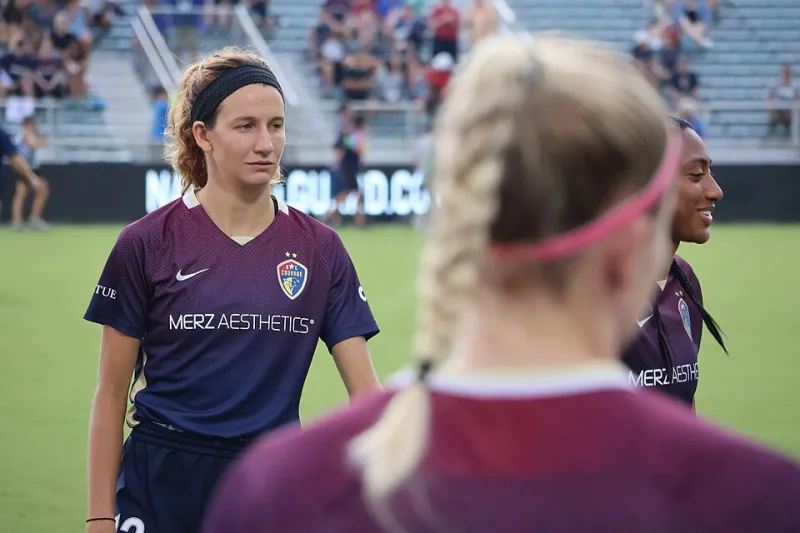
Photo: Hameltion, CC BY-SA 4.0, via Wikimedia Commons
Ask a teenager in Portland or Kansas City or North Carolina how they got into soccer, and you might be surprised by the answer. It's not always Messi. It's not always the Premier League highlights they found on YouTube at midnight. More and more, the answer involves a player like Trinity Rodman or Sophia Smith — someone they watched live, in person or on streaming, before they ever developed an opinion about the men's game at all.
That's a quiet revolution happening in American soccer culture, and it doesn't get nearly the attention it deserves.
A League That Used to Fight for Survival Is Now Fighting for Prime Time
The NWSL's story is, frankly, one of the more remarkable sports business comebacks in recent memory. The league has been through some genuinely dark moments — a predecessor league folding, ownership instability, years of being treated as an afterthought by domestic sports media. But something shifted around 2022 and 2023. Investment started flowing in. Expansion teams started selling out. Viewership numbers started climbing in ways that made network executives pay attention.
The 2023 NWSL Championship drew over 900,000 viewers on CBS — a number that would have seemed almost fictional a decade ago. Angel City FC in Los Angeles, a team that launched in 2022, averaged attendance figures that embarrassed some long-established MLS clubs. The Portland Thorns have been packing Providence Park for years. This isn't a niche phenomenon anymore. Something real is happening.
And the investment landscape reflects it. Private equity money, celebrity ownership groups, and serious media rights deals have all started flowing toward women's professional soccer in ways that signal a genuine belief in its long-term commercial viability. That's not charity. That's people who watch spreadsheets for a living deciding this is worth betting on.
The Fan Who Didn't Come From Men's Soccer First
Here's what makes this moment genuinely different from previous NWSL growth cycles: a significant chunk of the league's new fanbase isn't crossover audience from MLS or the Premier League. They're fans who found soccer through the women's game. That's a fundamentally different entry point into the sport, and it creates a different kind of fan.
Research on sports fandom consistently shows that how you first engage with a sport shapes what you value about it for years afterward. A fan who fell in love with soccer watching Alex Morgan or Megan Rapinoe at a World Cup, then followed those players into the NWSL, has a completely different frame of reference than someone who grew up watching Manchester United reruns on Fox Soccer Channel.
These fans tend to care more about domestic leagues. They're more likely to show up to local games. They're more invested in player storylines and club identity rather than just global superstar worship. For MLS, which has spent years trying to build that kind of deep local fandom, that's actually a roadmap — one being written by a different league.
What Youth Participation Numbers Are Telling Us
The downstream effects on youth soccer are already visible. Girls' participation in organized soccer has been climbing steadily, and coaches and club directors around the country will tell you the same thing: young girls are showing up to tryouts with a vocabulary for the game that previous generations didn't have. They're citing NWSL players as their idols. They're wearing club jerseys to school. The cultural machinery that turns sport into identity is running at full speed.
And here's the thing about youth participation that soccer's business side should be paying very close attention to: kids who play the sport become fans for life at dramatically higher rates than passive viewers. The NWSL isn't just building a fanbase for women's soccer. It's building soccer fans, period. Some of those fans will eventually watch MLS. Some will start following European leagues. The pipeline runs in all directions.
In markets like Seattle, Portland, and Washington D.C., where NWSL teams have been established longest, there's measurable evidence of this crossover effect. Soccer culture in those cities — the scarves, the supporter groups, the casual familiarity with tactical concepts — is richer and more layered than in cities without a women's professional team. That's not a coincidence.
Redefining What American Soccer Culture Looks Like
For most of its existence, American soccer fandom has been defined largely by its relationship to European football. The Premier League, La Liga, Champions League — these were the reference points, the cultural benchmarks. Domestic leagues existed somewhat in their shadow, always being compared unfavorably to the global standard.
The NWSL is doing something subtly different. It's creating soccer culture that's genuinely rooted in American places, American players, and American stories. The rivalries developing between clubs like Portland and Seattle, or the way Angel City has embedded itself in Los Angeles's broader cultural identity — these feel authentically local in a way that American soccer has always struggled to achieve.
That matters for the long game. Sports leagues that survive and thrive for generations aren't the ones that successfully import a foreign product. They're the ones that become part of the community fabric. The NWSL is doing exactly that, one sellout crowd at a time.
The Bigger Picture
None of this means the men's game is going anywhere. MLS is growing, the USMNT has a World Cup coming in 2026, and Premier League fandom in America isn't slowing down. But the assumption that American soccer fandom will always be organized primarily around men's football — with everything else as an afterthought — is looking shakier every year.
The NWSL isn't just a nice story about women in sports. It's actively rewriting who a soccer fan is in this country, what they care about, and how they engage with the game. That's a bigger deal than most of the soccer discourse in this country gives it credit for.
Pay attention. This is the part of the story people will be writing about for decades.