Going Viral Wasn't the Plan — But It Got Them Signed: How TikTok Is Rewriting Soccer Recruitment in America

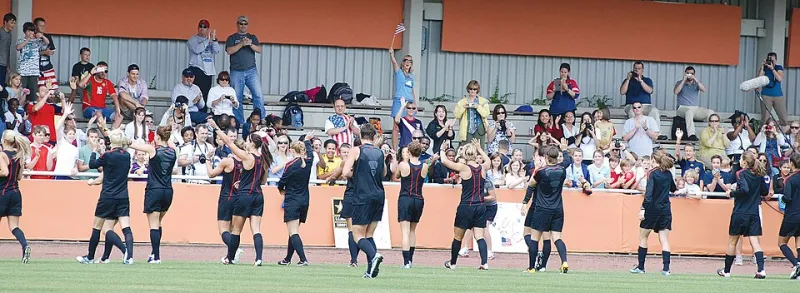
Photo: Okero Nyagaka, CC BY-SA 4.0, via Wikimedia Commons
Let's paint a picture. A seventeen-year-old in suburban Ohio records a first-touch volley during a pickup game, slaps a trending sound over it, and posts it to TikTok at 11 p.m. on a Tuesday. By Thursday, it has 800,000 views. By Friday, he's got three DMs from people claiming to represent professional clubs.
A few years ago, that scenario would've sounded like fiction. Today, it's basically a genre.
Social media has quietly — and then very loudly — started reshaping how young American soccer talent gets discovered. It's not replacing traditional pathways entirely, but it's poking holes in a system that was never as meritocratic as it claimed to be, and that's worth paying attention to.
The Old Pipeline and Its Gatekeepers
To understand why this shift matters, you have to understand how rigid the traditional recruitment path has been. For decades, getting noticed in American soccer meant either being enrolled in a high-level academy affiliated with an MLS club, competing in elite youth tournaments like ECNL or MLS NEXT, or catching the eye of a college recruiter. All of those routes require money — for registration fees, travel, equipment — and geography, because if you're not near a major metro area with club infrastructure, you're starting at a disadvantage.
That system has produced plenty of good players. But it's also filtered out a lot of talent that never got a fair look simply because the right scout wasn't in the right stadium on the right weekend.
Social media, at least theoretically, removes that gatekeeping. Your clip can reach anyone, anywhere, at any time. The algorithm doesn't care that you play for a mid-tier club in a secondary market.
Real Stories, Not Just Theory
The anecdotes are starting to stack up. There are players who built Instagram followings through consistent highlight content and ended up with trial invites from lower-division professional clubs. Goalkeeper coaches who found technically gifted keepers by following hashtags. Agents who now scroll TikTok as part of their regular scouting routine.
One semi-pro player from the Southeast — who asked to stay anonymous because he's still in contract discussions — told us he'd been passed over by three regional academies before a clip of him threading passes in a Sunday league game got picked up by a soccer content page with 400,000 followers. Within two weeks, he had a trial. Within two months, he had a contract.
"No one was coming to watch me play," he said. "The only way I was getting seen was if I put myself out there."
That's the compelling version of this story. And it's real.
The Credibility Problem Scouts Are Quietly Wrestling With
Here's where it gets complicated, though. Scouts and recruitment professionals are increasingly open about the challenge of evaluating players through social media content — because that content is, almost by definition, curated to impress.
A highlight reel is not a performance. It's the best ten seconds of a player's best moments, edited together with music, often slowed down, sometimes with camera angles that make routine plays look spectacular. What it doesn't show you is how that player reads the game off the ball, how they respond to a bad half, how they communicate with teammates, or what they look like in the 80th minute of a physical game.
"I've had players come in for trials who looked like genuine prospects on video," one scout at a USL club told us. "And then you see them in a structured session and you realize the clips were doing a lot of work."
This isn't unique to soccer — the same debate is happening in basketball and other sports. But soccer's complexity makes it particularly susceptible to misleading highlight content. A player who's great in a pickup game or small-sided format may have real technical gifts but lack the tactical understanding and physical conditioning that professional play demands.
Are We Building Unrealistic Expectations?
There's also a mental health angle here that doesn't get discussed enough. When a teenager's soccer clip goes viral, the response can be overwhelming — thousands of comments calling them the next Messi, DMs from people with dubious credentials offering "representation," and an inflated sense of where they stand in the actual competitive landscape.
Parents and players who don't have experience navigating professional soccer can easily mistake social media attention for genuine professional interest. The line between a scout reaching out and a content creator looking to collaborate isn't always obvious to a sixteen-year-old.
"We've seen kids turn down legitimate college scholarships because they thought viral attention meant they were going pro," said one youth coach who works with high school-aged players in the Pacific Northwest. "It's heartbreaking when reality catches up."
That's not an argument against social media recruitment. It's an argument for better education around what it actually means when your video gets traction.
The Democratization Is Real — But It's Not Complete
Here's where I land on this: the social media shift in soccer recruitment is genuinely meaningful, and dismissing it as a gimmick misses something important. It has created pathways for players who would've been invisible in the old system. It's forced scouts to look in places they wouldn't have looked before. And it's put pressure on a recruitment infrastructure that has long benefited from limited information flow.
But it hasn't leveled the playing field. It's just added a new lane. The players who thrive in this new environment still tend to be the ones with real ability — social media amplifies talent, it doesn't manufacture it. And the structural advantages of elite academies, professional coaching, and well-funded club environments haven't disappeared just because a kid in Ohio can go viral.
What's changed is the ceiling on visibility. And for a sport that has historically struggled to find and develop talent across America's full geographic and economic diversity, that's not nothing.
The clubs and scouts who figure out how to integrate social media discovery with rigorous in-person evaluation will have a real edge. The ones who either ignore it or over-rely on it will keep making the same mistakes — just with better content.