Lines in the Sand: How American Soccer Keeps Fumbling the Offside Rule

There's a particular kind of frustration that every soccer fan in America knows well. The kind where a striker peels away from the last defender, slots the ball into the net, and the stadium erupts — only for a flag to go up, the goal to get wiped away, and the replay to show... absolutely nothing wrong. Or worse, the flag stays down when it should've gone up, and a clearly offside goal stands because the assistant referee was half a step out of position.
It happens in the Premier League too, sure. But over there, they've built an entire semi-automated tracking system to minimize those moments. Here in the States, we're still arguing about whether the guy on the touchline was even watching the right player.
So what's actually going on? Why does offside remain the most consistently botched call in American soccer, from MLS all the way down to USL and beyond?
The Basics Nobody Gets Right
Here's the thing about offside: it's deceptively simple on paper. A player is offside if any part of their body they can legally score with is closer to the opponent's goal line than both the ball and the second-to-last defender at the moment the ball is played. That's it. That's the rule.
But executing that call in real time, while tracking a ball moving at 60 miles per hour and multiple bodies shifting simultaneously, is genuinely hard. Elite assistant referees in top European leagues spend years learning to read the game's rhythm, to anticipate the pass rather than react to it. Timing is everything — and timing is exactly where American officials keep getting burned.
The issue isn't that American referees don't know the rule. They do. The issue is the split-second synchronization between when the ball leaves a player's foot and when the assistant referee freezes the frame in their mind. Get that wrong by even a half-second, and you're either ruling a legitimate goal offside or waving through something that shouldn't count. Both happen in MLS with an uncomfortable regularity.
MLS Has the Tech — Just Not the Consistency
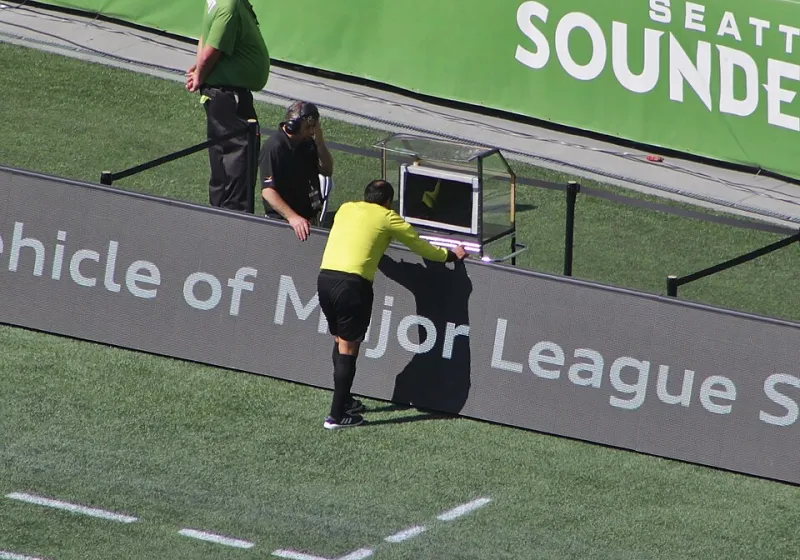
MLS introduced VAR back in 2017, making it one of the earlier adopters among major professional leagues worldwide. That should have fixed things, right? Well, not exactly.
The problem with VAR in MLS isn't the technology itself — it's the interpretation standards that sit behind it. In the Premier League, PGMOL (the body that governs officiating) issues regular clarifications, holds referees accountable through public performance reviews, and applies a standardized margin of error when drawing offside lines. MLS's equivalent body, Professional Referee Organization (PRO), has made strides in transparency, but the consistency just isn't there yet.
Talk to fans in cities like Columbus, Portland, or Austin, and you'll hear the same complaints season after season. Calls that look clean get flagged. Goals that seem obviously offside somehow survive review. The lines drawn during VAR checks appear inconsistent from week to week, sometimes even match to match within the same stadium. It creates this maddening sense that the rulebook is being applied differently depending on who's officiating — which, honestly, it probably is.
A Training Pipeline That's Still Playing Catch-Up
Part of the problem runs deeper than any single bad call. American soccer's officiating pipeline is still maturing, and it shows.
In countries with longer professional soccer histories, referee development is treated with almost the same seriousness as player development. Young officials move through structured academies, get mentored by experienced veterans, and accumulate hundreds of hours of high-level match experience before they're anywhere near a top-flight game. The culture around officiating is different — it's a career path, not a side gig.
In the United States, the sport simply hasn't been around long enough at the professional level to build that same depth. MLS only turned 30 this year. Many of its current officials came up through youth leagues and college soccer — environments where the pace, physicality, and tactical complexity are genuinely different from what they face on a Saturday night in front of 25,000 people. That gap in preparation shows up most clearly on the toughest calls, and offside is about as tough as it gets.
PRO has been working to change this, investing in video analysis tools, bringing in European consultants, and expanding its referee development programs. But culture shifts don't happen overnight, and in the meantime, fans are still watching flags go up at the wrong moment.
The Lower Leagues Are Even Rougher
If MLS officiating is a work in progress, the lower levels of American soccer are a whole different story. In USL Championship, USL League One, and especially the amateur tiers, offside calls can feel almost random. Resources are limited, training is inconsistent, and assistant referees are sometimes running three matches in a weekend just to cover the schedule.
Those conditions make accurate offside calls nearly impossible. You're asking part-time officials, often working for modest pay, to execute one of the game's most technically demanding judgments under pressure. It's not a knock on the individuals — many of them are genuinely dedicated to the craft. It's a structural problem that reflects how underinvested officiating has been at the grassroots level for decades.
And here's why that matters beyond just the lower leagues: the officials who eventually make it to MLS came from somewhere. If the foundational training isn't there at the bottom, the problems don't disappear when someone gets promoted — they just move up with them.
What Would Actually Help
So what's the fix? A few things could genuinely move the needle.
First, semi-automated offside technology — the kind UEFA has deployed in Champions League matches — needs to become a realistic goal for MLS within the next few years. The league has the financial backing and the broadcast infrastructure to make it work. Right now, it's drawing lines manually on a frozen video frame during VAR reviews, which introduces human error right back into a process designed to eliminate it.
Second, PRO needs to get more aggressive about public accountability. When a high-profile offside call goes wrong, the league and its officiating body should be explaining what happened, how the error occurred, and what's being done to prevent it. Silence breeds cynicism, and American soccer fans have become very good at cynicism.
Third — and this is the long game — investment in youth referee development has to be treated as seriously as investment in youth player development. The sport can't keep asking officials to figure it out on the fly at the professional level when the groundwork was never properly laid.
The Bottom Line
Offside isn't a glamorous problem. It doesn't generate the same headlines as a big transfer or a playoff collapse. But it's the kind of persistent, grinding issue that quietly erodes trust in the product — and in a country where soccer is still fighting for living room real estate against the NFL, NBA, and MLB, that trust matters.
American soccer has come a long way in thirty years. The stadiums are better, the players are better, and the tactical sophistication is genuinely improving. But until the officiating catches up — until the flag goes up at the right moment, every time, for the right reasons — there'll always be a blind spot at the heart of the game here. And fans will keep noticing.